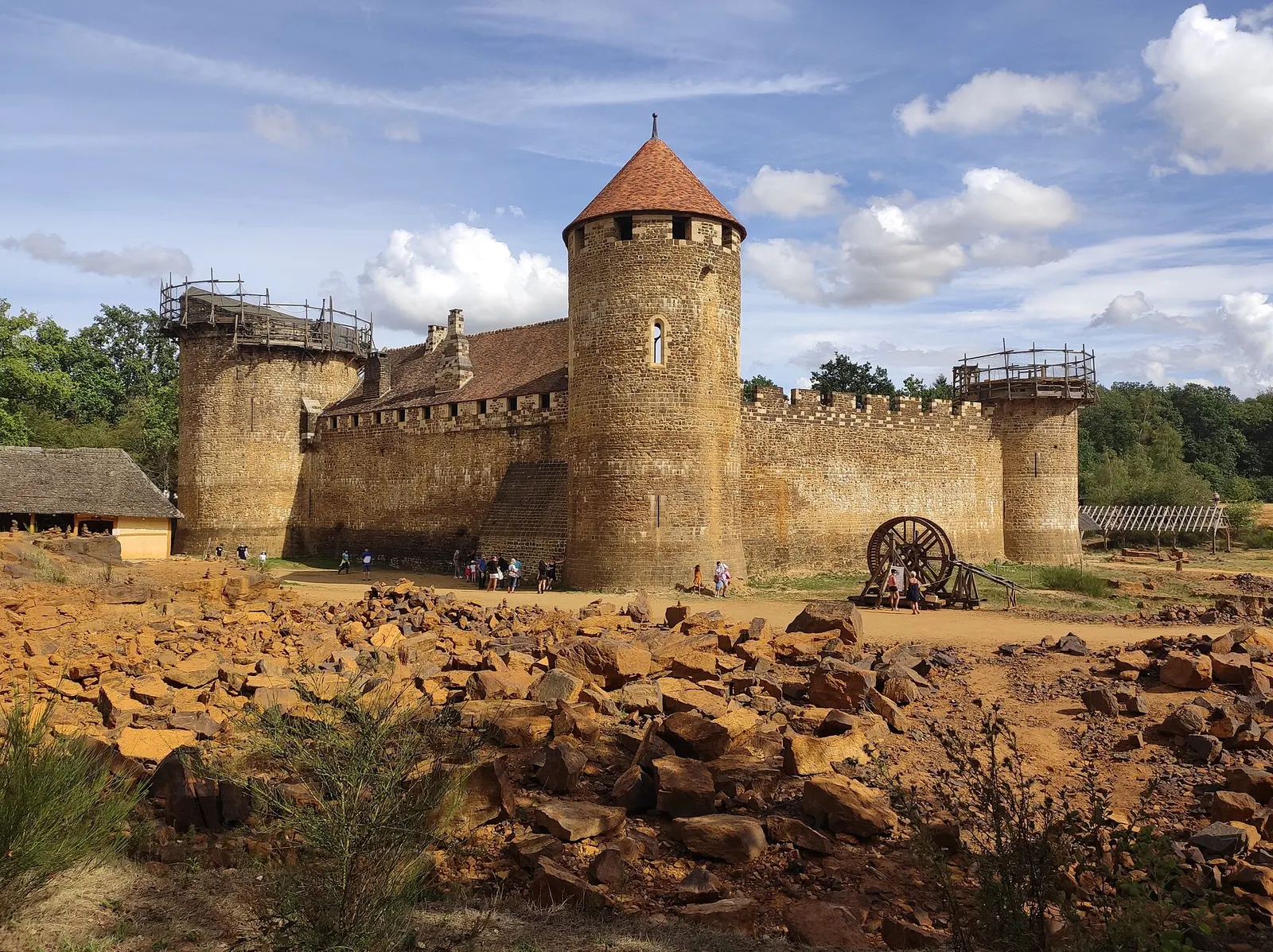
What you will see
You follow a path around the castle and its workshops. Quarrymen split the sandstone, stonecutters shape the blocks, masons raise the walls, and carpenters build scaffolding and roof frames. Around them, woodcutters, blacksmiths, tile makers, rope makers and carters work at their crafts with period tools. Everything is made from the stone, wood and earth of the site. The builders explain their methods as they go, and the castle changes a little every season.
History
The idea came from Michel Guyot, owner and restorer of the Château de Saint-Fargeau nearby, and Maryline Martin, who became director of the project. They chose an old quarry of iron-rich sandstone in the forest of Guédelon, close to wood, clay and water, as medieval builders would have done. A scientific committee of castle experts backs the project, and the plans were drawn by Jacques Moulin, chief architect of historic monuments.
The first stone was laid on 20 June 1997. The castle follows the model of the time of Philip Augustus, with six round towers linked by curtain walls and a walkway around a perimeter of about 150 metres. Work advances as it would have done in the Middle Ages, solving problems one by one. The site has become a centre of experimental archaeology as well as a place to visit.