10 min read · Written and checked by Côte Privée, updated
Burgundy classifies places, not producers: its 84 appellations sit on four levels, from regional wines through village and premier cru to 33 grands crus. According to the Burgundy wine board (BIVB), regional appellations make up 53% of production, village and premier cru wines 46% and grands crus just 1%. Once you see that the name on the label is a map reference, the whole system falls into place.
In short
- Burgundy has 84 AOCs: 7 regional, 44 village and 33 grand cru appellations (BIVB).
- Premier cru is not a separate AOC but a named climat inside a village appellation; BIVB counts 662 of them.
- By volume, regional wines are 53% of production, village and premier cru 46% and grand cru 1% (BIVB, 2019 to 2023 average).
- A climat is a precisely bounded vineyard plot known by its name for centuries; a lieu-dit is simply a named place on the land register.
How is Burgundy wine classified?
Burgundy wine is classified by vineyard location into four levels: regional, village, premier cru and grand cru. The higher the level, the smaller and more precisely defined the area, and the stricter the rules on yield and minimum natural ripeness.
The system rests on the appellation d'origine contrôlée (AOC), supervised by INAO, France's national institute of origin and quality. Every appellation has a cahier des charges, a legal specification that fixes the permitted area down to the parcel, the grape varieties, planting density, maximum yield and labelling. The first Burgundy AOCs date from 1936, and they drew on 19th-century rankings by André Jullien in 1816, Denis Morelot in 1831 and Jules Lavalle in 1855, as BIVB points out.
Unlike Bordeaux, which ranked châteaux, Burgundy ranked terroirs. A grand cru is a piece of ground, whoever farms it, which is why one vineyard can be shared by dozens of owners, each making a different wine under the same name.
| Level | Number of AOCs | Share of production (BIVB) | What it covers | Label example |
|---|---|---|---|---|
| Regional | 7 | 53% | Large areas across Burgundy, sometimes with an added place name | Bourgogne, Bourgogne Aligoté, Crémant de Bourgogne |
| Village | 44 | 46%, together with premier cru | One commune or a small group of communes | Meursault, Gevrey-Chambertin, Mercurey |
| Premier cru | None of its own: 662 climats inside village AOCs | Included in the village figure | A named climat of higher standing within a village appellation | Meursault Premier Cru Les Perrières |
| Grand cru | 33 | 1% | A single outstanding climat with its own appellation | Clos de Vougeot, Montrachet, Chablis Grand Cru |
What are Burgundy’s regional appellations?
Regional appellations form the base of the pyramid: wines that may come from vineyards across Burgundy or a large part of it. BIVB counts seven: Bourgogne, Bourgogne Aligoté, Bourgogne Passe-tout-grains, Coteaux Bourguignons, Crémant de Bourgogne, Bourgogne Mousseux and Mâcon.
This is the level where Burgundy allows more than Pinot Noir and Chardonnay. Bourgogne Aligoté is made only from Aligoté, Passe-tout-grains must blend Pinot Noir with Gamay, and Coteaux Bourguignons, created in 2011 to replace Bourgogne Grand Ordinaire, can use Gamay, Pinot Noir, Aligoté, Chardonnay, Melon, Pinot Blanc and Pinot Gris. Crémant de Bourgogne is the region's traditional-method sparkling wine.
Some regional wines add a place name, called a dénomination géographique complémentaire. The Bourgogne appellation has more than a dozen, including Bourgogne Hautes Côtes de Nuits, Bourgogne Hautes Côtes de Beaune, Bourgogne Côte d'Or, Bourgogne Côte Chalonnaise and Bourgogne Tonnerre. Mâcon can be followed by the name of one of 27 villages, as in Mâcon-Lugny or Mâcon-Chardonnay, or sold as Mâcon-Villages. These names narrow the origin without creating a new appellation.
What is a village appellation?
A village appellation is named after the commune, or small group of communes, where the grapes grow: Pommard, Meursault, Mercurey or Pouilly-Fuissé, for example. Burgundy has 44 of them, including Chablis, Petit Chablis, Côte de Nuits-Villages and Côte de Beaune-Villages.
Several spread over more than one commune. The Gevrey-Chambertin appellation extends into Brochon, Vosne-Romanée includes vines in Flagey-Échezeaux, and Chablis takes in 20 villages. Many villages added the name of their most famous vineyard to their own in the 19th century, which is why so many hyphenated names end in a grand cru: Gevrey took Chambertin in 1847, while Puligny and Chassagne took Montrachet in 1879.
A village wine may blend plots from anywhere inside the appellation. When it comes from a single named plot that is not a premier cru, the label may show that lieu-dit, but in letters no more than half the height and width of the appellation name, as in Meursault Les Narvaux. That rule, written into specifications such as Gevrey-Chambertin's, stops a village plot from looking like a premier cru.
What does premier cru mean in Burgundy?
Premier cru, often written 1er Cru, marks a named climat of higher standing inside a village appellation. It is not an appellation of its own: Meursault Premier Cru Les Perrières is legally the Meursault appellation with a premier cru climat attached. BIVB counts 662 climats classified as premiers crus.
The lists were written into the village decrees in 1943. BIVB explains the timing: during the Occupation the grands crus were spared from requisition, and growers argued that other famous climats deserved the same treatment.
On the label the village name comes first, then Premier Cru or 1er Cru and, usually, the climat name, printed no larger than the village name. A wine blended from several premier cru climats of the same village is labelled simply, for example, Beaune Premier Cru. Numbers vary widely: Gevrey-Chambertin has 26 premier cru climats, Chassagne-Montrachet 55 and Chablis 40, while many villages have none. New ones still appear: Pouilly-Fuissé gained 22 premiers crus from the 2020 vintage, and a request from the growers of Marsannay-la-Côte went to public consultation in 2026.
What is a grand cru in Burgundy?
A grand cru is a single outstanding climat with an appellation of its own. There are 33: 24 in the Côte de Nuits, 8 in the Côte de Beaune, and Chablis Grand Cru, one appellation divided into seven named climats.
A grand cru label shows the vineyard name alone, such as Montrachet, Clos de Vougeot or Romanée-Conti, followed by the words Grand Cru. The village name does not appear, and the specifications forbid mentioning the grape variety. Together these vineyards give about 1% of Burgundy's wine.
Two grands crus may add a climat name: red Corton, whose specification lists 25 climats such as Les Bressandes and Le Clos du Roi, and Chablis Grand Cru, with Blanchot, Bougros, Les Clos, Grenouilles, Preuses, Valmur and Vaudésir. Our guide to the grand crus lists all 33 with their sizes.
How is a climat different from a lieu-dit?
A climat is a precisely bounded vineyard plot, known by its name for centuries, whose wine is made and sold under that name, while a lieu-dit is simply a named place on the land register, and the two do not always match: the Chambertin appellation covers two lieux-dits, Chambertin and Clos de Bèze. Where the word comes from, and why UNESCO listed 1,247 climats of the Côte de Nuits and the Côte de Beaune, is told in our guide to the Climats of Burgundy.
How do you read a Burgundy wine label?
Read a Burgundy label from the place outwards: find the appellation, check for Premier Cru or Grand Cru, look for a climat name, then find the producer.
- Appellation: the key place name, confirmed by a phrase such as Appellation Gevrey-Chambertin Contrôlée or Appellation d'Origine Protégée.
- Level: Grand Cru after a vineyard name marks the top rank; Premier Cru or 1er Cru after a village name marks the second.
- Climat or lieu-dit: a premier cru climat may be printed as large as the village name, a village-level lieu-dit at no more than half its size.
- Producer: the name and address of the domaine, négociant house or cooperative, often with mis en bouteille au domaine for estate bottling.
- Grape variety: usually absent. It is forbidden on grand cru labels, and village specifications such as Gevrey-Chambertin's restrict it to small print away from the main information.
- Vintage, alcohol and volume: the vintage is optional by law but almost always shown; Vin de Bourgogne or Grand Vin de Bourgogne is optional wording that adds no rank.
What is the difference between a domaine, a négociant and a cooperative?
A domaine grows its own grapes and makes wine from them; a négociant buys grapes, must or wine from growers and sells it under its own name; a cooperative makes and sells wine for its grower members. All three can produce excellent Burgundy, so the appellation usually tells you more than the business model.
Beaune's négociant houses developed from the 18th century, buying wine, ageing it in their cellars and building trade networks across France and northern and eastern Europe, as the Association des Climats recounts. Today many négociants also own large vineyards, and many growers buy grapes to widen their range, so the line is blurred. Two words carry legal weight: under a French decree of 4 May 2012, Domaine and Monopole may be used only for wines made from grapes harvested on the named estate's own plots and vinified there.
The average Burgundy estate farms 8.51 hectares (BIVB), often spread over many appellations, which is why one grower may offer ten or more wines. In Beaune, houses such as Maison Joseph Drouhin open their cellars to visitors, while in Chablis the cooperative La Chablisienne, founded in 1923, pours every level of the appellation in one room.
| Type | How it works | Number in Burgundy (BIVB, 2024) |
|---|---|---|
| Domaine | Grows, makes and usually bottles wine from its own vines | 3,489 estates, of which 1,926 sell more than 10,000 bottles a year |
| Négociant house (maison) | Buys grapes, must or wine, then makes, ages and sells it; many also own vineyards | 316 houses |
| Cooperative cellar | Makes and markets the wine of its grower members | 16 cooperatives |
How much Burgundy is regional, village, premier cru or grand cru?
By volume, just over half of Burgundy is regional wine, a little under half is village and premier cru, and about 1% is grand cru. These are BIVB's official key figures, based on the 2019 to 2023 average.
| Level | Share of average production (BIVB, 2019 to 2023) |
|---|---|
| Regional appellations | 53% |
| Village and premier cru appellations | 46% |
| Grand cru appellations | 1% |
Why is there no official figure for premier cru alone?
BIVB publishes village and premier cru wines as one group, so be wary of figures that split them out. It does break the non-regional wines down by district: Chablis and the Grand Auxerrois account for 20% of Burgundy's production, the Côte de Beaune 11%, the Mâconnais villages 6%, and the Côte de Nuits and the Côte Chalonnaise 5% each.
Across all levels, Burgundy averages 1.49 million hectolitres a year from 32,301 hectares, with white wine at 61%, red and rosé at 27% and Crémant de Bourgogne at 12% (BIVB, September 2024).
Where do the levels sit on the slope?
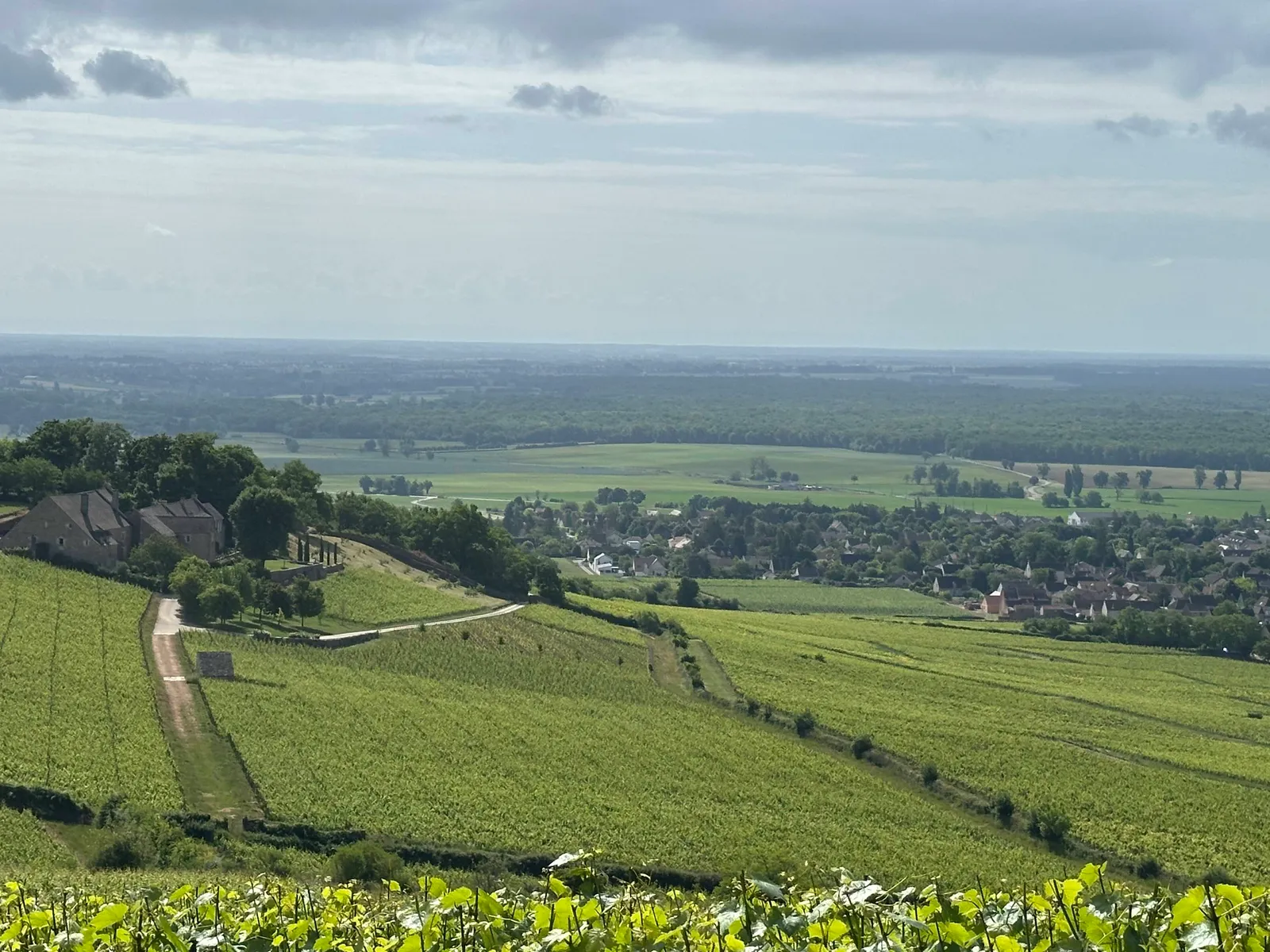
Where a village has every level, BIVB notes that premiers and grands crus usually occupy the middle of the slope, village vines lie above and below them, and regional vines sit at the foot. Vosne-Romanée shows it well: the grands crus rise directly above the village, a short walk up to the stone cross of La Romanée-Conti vineyard, with premiers crus on either side and village-level vines lower down towards the main road.
The easiest way to understand the hierarchy is to taste it: a regional, a village, a premier cru and, if you are lucky, a grand cru from the same cellar. With a driver, everyone in the group can taste; our half-day tour lasts 4 hours and costs 290 euros, with tastings paid directly to the domaines.
Questions
84 AOCs according to BIVB: 7 regional, 44 village and 33 grand cru appellations. Premiers crus are not counted separately because they sit inside village appellations.
Sources