8 min read · Written and checked by Côte Privée, updated
Most Burgundy domaines receive visitors by appointment only, so book tastings ahead, while tasting venues and several large houses in Beaune open daily and charge about €15 to €30 per person for a standard visit in 2026. Expect about an hour, four to seven wines and a spittoon, with no obligation to buy. Taking wine home is easy within the EU, but duty-free allowances elsewhere are small: 18 litres of wine into Great Britain, 1 litre into the US and 1.5 litres into mainland China.
In short
- Burgundy has about 3,489 wine estates, 316 négociant houses and 16 cooperative cellars, according to the BIVB; the average estate farms about 8.5 hectares.
- Book family domaines ahead; tasting venues and several large houses in Beaune open every day.
- Standard visits in Beaune cost about €15 to €30 per person in 2026; tastings of premiers and grands crus cost more.
- Spitting is normal and expected, and buying is welcome but not compulsory.
Do you need to book wine tastings in Burgundy?
Yes for family domaines, which receive visitors by appointment; not always for the large houses and tasting venues in Beaune.
Most Burgundy estates are small family businesses. According to the BIVB, the region's wine board, the average estate farms about 8.5 hectares, and the person who pours your wine may have spent the morning in the vines. There is often no tasting room or staff for walk-in visitors, so write or call well ahead, and earlier still between May and October.
The wine board lists more than 260 tourist cellars with the Vignobles & Découvertes label, which commit to receiving visitors and are a good starting point. In Beaune, venues such as the Marché aux Vins, the Cité des Climats et vins de Bourgogne and Maison Patriarche Père et Fils sell visits online.
What is the difference between a négociant house and a domaine?
A domaine makes wine from its own vineyards; a négociant house, or maison, also buys grapes, must or young wine from growers, then ages and bottles it under its own name.
The BIVB counts 3,489 domaines, of which 1,926 sell more than 10,000 bottles a year, alongside 316 négociant houses and 16 cooperative cellars. Many great houses also own large estates, so the line is not rigid. For visitors, the real difference is the kind of visit you get.
| Type | Examples | Booking | What you taste | Typical visit |
|---|---|---|---|---|
| Négociant house | Maison Joseph Drouhin, Bouchard Aîné & Fils, Maison Champy, Maison Patriarche Père et Fils | Online, often open most days | A wide range across many appellations | Guided or self-guided cellar walk at a fixed price |
| Family domaine | Growers in every village of the Côte | By appointment, well ahead | The estate's own climats, often a short list | Tasting with the grower in the cellar |
| Cooperative | La Chablisienne in Chablis | Tasting room open to walk-ins; private tastings booked | A full range of an area | Tasting counter and shop |
How much does a wine tasting cost in Burgundy?
In Beaune, a standard visit with tasting costs about €15 to €30 per person in 2026, and tastings of premiers and grands crus from about €49. The prices of each house and château, checked on their websites, are in our guide to what a private wine tour costs.
What happens during a cellar visit?
You usually see where the wine is made and aged, then taste four to seven wines, working up from regional or village wines to premiers or grands crus.
- A welcome in the courtyard or tasting room, with a word on the estate and its vineyards.
- The cuverie, or vat house, where grapes are sorted and fermented; at harvest time it is busy and noisy.
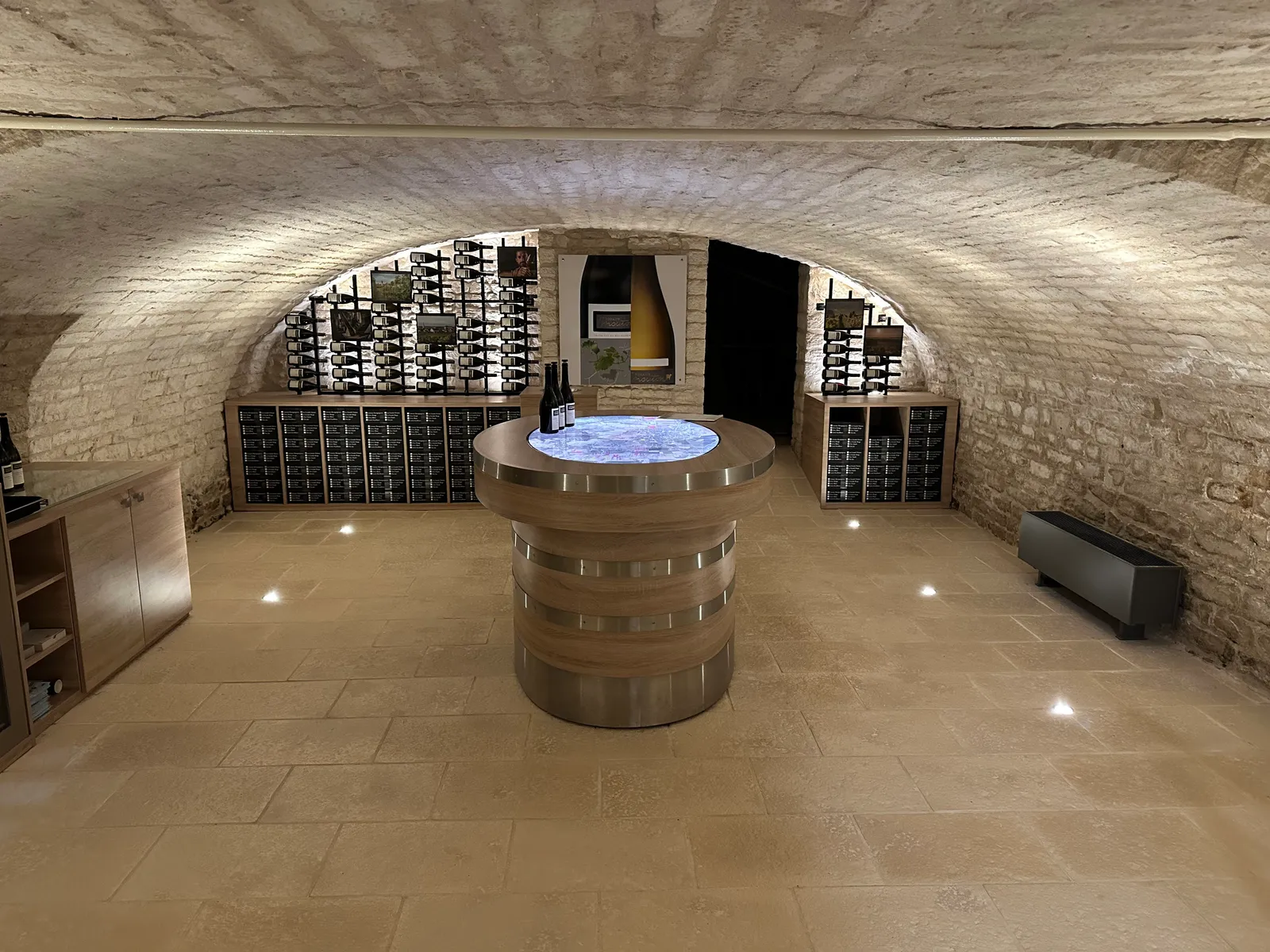
- The cellar, often vaulted and cool all year, where the wine ages in oak barrels. Bring a light layer and wear flat shoes.
- The tasting itself, from the lightest wines to the most structured, often whites first and then reds. At some domaines you taste the young vintage straight from the barrel.
- Time for questions and, if you wish, for buying.
How long does a Burgundy cellar visit last?
Allow an hour to an hour and a half, including the tasting.
In Beaune the cellars under the old town are extensive. Those of Maison Patriarche Père et Fils run for about five kilometres, and Domaine Chanson ages its wines on four levels inside a bastion of the ramparts. A self-guided tasting at the Marché aux Vins takes about an hour; guided visits and grand cru tastings take longer.
What is the etiquette at a Burgundy tasting?
Arrive on time, spit, ask questions and buy only what you like.
- Be punctual and warn the domaine if you are running late; a grower may have left the vines to receive you.
- Skip perfume and strong aftershave, which blur aromas for everyone in a small cellar.
- Use the spittoon. Spitting is normal, even for grands crus, and pouring away what is left in your glass is not rude.
- Ask about the climat, the vintage and the work in the vineyard; Burgundians enjoy talking about their plots.
- Buying is welcome, and at a small domaine a few bottles are a good way to say thank you, but it is not compulsory, especially when you have paid for the tasting.
- Ask before taking photos in a working cellar.
When are Burgundy cellars closed?
Family domaines often close on Sundays and public holidays, some also on Mondays, and many are hard to visit during the harvest; the large houses and venues in Beaune generally open every day.
Harvest usually falls between late August and late September, but it can start earlier: in 2026 it began on 8 August with grapes for Crémant de Bourgogne, and the last grapes came in just before mid-September. During those weeks small domaines have little time for visitors, and some family estates also close for a holiday in August. By contrast, the Marché aux Vins opens every day except around Christmas and New Year and for two weeks in January, La Chablisienne's tasting cellar in Chablis opens seven days a week, and the Cité des Climats et vins de Bourgogne in Beaune is open daily except on 25 December and 1 January.
| Period | What to expect |
|---|---|
| May to mid-October | The busiest season; book tastings early |
| Late August to late September | Harvest; small domaines have little time for visitors |
| August | Some family domaines close for a holiday |
| Mid-November | The Vente des Vins des Hospices de Beaune weekend, with the auction on Sunday 15 November 2026; special tastings, and the town is full |
| December to March | Quieter; some venues shorten their hours |
How much wine can you take home from Burgundy?
Within the EU there is no fixed limit on wine you carry for your own use; outside the EU, duty-free allowances are much smaller and duty applies above them.
- These are the rules published by the European Union, GOV.UK, US Customs and Border Protection, the Swiss customs office (FOCBS) and China's customs authorities; they change, so check before you travel.
- Allowances apply to wine you carry yourself. Wine sent by a carrier to a country outside the EU is taxed on arrival, and in the US state rules decide whether it can be delivered to a private address.
- Many domaines ship abroad or work with specialist shippers, so ask when you buy.
- If you fly, pack bottles in checked luggage in protective sleeves, as most airports still limit liquids in cabin bags.
| Arriving in | Duty-free wine allowance | Above the allowance |
|---|---|---|
| Another EU country | No fixed limit for your own use; guide level of 90 litres per person, of which up to 60 litres sparkling | Larger amounts may be treated as commercial |
| Great Britain | 18 litres of wine, still or sparkling, about 24 bottles, plus 9 litres of fortified wine such as port or sherry or other drinks up to 22%, or 4 litres of spirits, or a split of these two; aged 17 or over | Tax and duty on the whole category, not just the excess |
| United States | 1 litre of alcoholic drinks, aged 21 or over | Duty and federal tax on the rest, and state laws may be stricter |
| Switzerland | 5 litres of drinks up to 18% alcohol per person and per day, aged 17 or over | Duty of CHF 2 per litre above the allowance, and Swiss VAT if all the goods carried are worth more than CHF 150 |
| Mainland China | 1.5 litres of alcoholic drinks of 12% or more, or 0.75 litres for travellers arriving from Hong Kong or Macao; aged 18 or over | Declared at customs; duty charged on the excess |
Why use a driver for a Burgundy wine tasting day?
Because the French drink-drive limit is low, 0.5 g of alcohol per litre of blood, or 0.2 g for drivers on a probationary licence, and even with careful spitting a day of tastings adds up.
Between 0.5 and 0.8 g per litre the offence usually means a fixed fine of €135 and the loss of 6 points on a French licence, and the car can be immobilised; from 0.8 g per litre it becomes a criminal offence. With a driver nobody has to drive, and the cases ride in the boot. Our wine days start at €290 for 4 hours, per vehicle for up to four guests, and we book the domaines for you at no extra charge.
Questions
Usually four to seven, sometimes more at a large house. At the Marché aux Vins in Beaune, the standard self-guided formulas offer five or seven wines.
Sources