10 min read · Written and checked by Côte Privée, updated
The Climats of Burgundy were inscribed on UNESCO's World Heritage List on 4 July 2015. The listing covers 1,247 precisely delimited vineyard plots, or climats, on the slopes of the Côte de Nuits and the Côte de Beaune, together with the town of Beaune and the historic centre of Dijon: 13,219 hectares in all, within a buffer zone of 50,011 hectares. It recognises a system in which wine has been tied to its exact plot of origin since the Middle Ages.
In short
- Official name: The Climats, terroirs of Burgundy, inscribed on 4 July 2015 at the 39th session of the World Heritage Committee in Bonn.
- UNESCO counts 1,247 climats on the slopes that run about 50 km south of Dijon to the Maranges.
- The property has two parts: the vineyards, wine villages and town of Beaune (13,118 ha) and the historic centre of Dijon (101 ha), with a 50,011 ha buffer zone.
- It was listed under criteria (iii) and (v), as the living archetype of terroir winegrowing shaped by monks, dukes, towns and growers.
What is a climat in Burgundy?
In Burgundy, a climat is a named vineyard plot, gradually and precisely bounded by people over centuries, with its own geology, water drainage and exposure. Its grapes are vinified separately and the wine carries its name. The word has nothing to do with the weather.
The Association des Climats du vignoble de Bourgogne, which carried the World Heritage bid, notes that the term first appeared in writing in the 16th century as a synonym for lieu-dit, and spread in the 17th century to express the differences and hierarchy between the wines of the Côte. A document of 1584 about the Clos de Bèze already mentions a piece of vine in the climat of Champ Berthin, today's Chambertin.
Every grand cru and every premier cru is a climat, but so are many village-level plots. As the writer Bernard Pivot, who chaired the committee supporting the bid, put it, when Burgundians speak of a climat they look down at the soil, not up at the sky.
What exactly did UNESCO list in 2015?
UNESCO listed a serial cultural property in two parts: the vineyards of the Côte de Nuits and the Côte de Beaune with their villages and the town of Beaune, and the historic centre of Dijon. UNESCO describes the first as the commercial side of the system and Dijon as the political and regulatory power that gave birth to it.
| Part | What it includes | Area |
|---|---|---|
| Component 1425-001, the vineyards | 1,247 climats on the slopes from Dijon to the Maranges, the wine villages and their buildings, and the town of Beaune | 13,118 ha |
| Component 1425-002, Dijon | The historic centre, seat of the dukes and of the institutions that regulated the vineyard | 101 ha |
| Total listed property | Both components | 13,219 ha |
| Buffer zone | The landscape setting, reaching into the Hautes-Côtes in the west and to the A31 motorway in the east | 50,011 ha |
How big is the Climats World Heritage site?
The listed property covers 13,219 hectares, within a buffer zone of 50,011 hectares. UNESCO's summary describes natural hillsides with clay-limestone soils of extremely variable composition extending 50 km south of Dijon to the Maranges.
According to the Association des Climats, the core zone takes in about 40 communes, and the buffer zone and associated communes about a hundred more; BIVB puts the total at 142 communes. The buffer zone follows the highest contour lines in the Hautes-Côtes to the west, the A31 motorway to the east and the Dijon bypass to the north.
Three monuments are singled out by UNESCO as the tangible trace of the powers that built the system: the Palais des Ducs et des États de Bourgogne in Dijon, the Hôtel-Dieu des Hospices Civils de Beaune and the Château du Clos de Vougeot.
Is all of Burgundy a World Heritage site?
No. The listing covers only the Côte de Nuits and the Côte de Beaune, from Dijon to the Maranges, plus Dijon and Beaune. Chablis, the Auxerrois, the Côte Chalonnaise and the Mâconnais lie outside it, and parts of the Hautes-Côtes fall only within the buffer zone.
The Association des Climats explains the choice: the bid focused on the stretch that best demonstrated the model, while the benefit was meant for the whole of Burgundy, hence the name Climats du vignoble de Bourgogne. The region has other World Heritage sites listed for different reasons, including the Abbaye de Fontenay and the Basilique Sainte-Marie-Madeleine de Vézelay.
Why were the Climats of Burgundy listed?
UNESCO judged the Climats to be the birthplace and living archetype of terroir winegrowing: a landscape where, since the High Middle Ages, wine has been identified with its exact plot of origin to the highest degree, and where that system is still alive. It was inscribed under two criteria.
- Criterion (iii): the combination of vineyard parcels, wine villages and the towns of Dijon and Beaune is a remarkable example of a historic vineyard landscape, with at least ten centuries of accumulated know-how and viticulture that is still active.
- Criterion (v): the Climats show how a community chose place, the climat, and time, the vintage, as its markers of quality, and the parcels remain visible in walls, clos, stone heaps called meurgers, hedges and paths.
- Integrity and authenticity: the parcel pattern has barely changed, the land is still farmed for wine, and the appellation rules in force since 1936 help keep boundaries stable.
How long did the UNESCO bid take?
About eight years. The association behind the bid was created in April 2007, chaired by the winegrower Aubert de Villaine, with Bernard Pivot leading the support committee. France placed the Climats on its tentative list in April 2009, and a scientific committee of 36 specialists, from geologists and historians to linguists and agronomists, helped prepare a dossier of more than 600 pages.
A Territorial Charter setting out how the site would be managed was signed on 8 April 2011 at the Château du Clos de Vougeot. The dossier was submitted to UNESCO in January 2014, international experts visited in the autumn of 2014, and the World Heritage Committee voted at its 39th session in Bonn on 4 July 2015. More than 64,000 people had signed in support by then, according to BIVB. The same session also inscribed the Champagne hillsides, houses and cellars.
How did monks and dukes shape the Climats?
Monks gave the Climats their method, the Valois dukes gave them their reputation, and the towns of Dijon and Beaune turned both into rules and trade.
Vines grew here in Roman times: in 2008 archaeologists found a vineyard of the 1st and 2nd centuries AD on the plain at Gevrey-Chambertin. From the Middle Ages the great abbeys took the lead. Cluny, founded in 910, and the Abbaye Notre-Dame de Cîteaux, founded in 1098, both born in Burgundy, acquired, cleared and walled vineyards along the Côte. The Cistercians created the Clos de Vougeot in the 12th century, a model of walled vineyard and monastic winery that spread across Europe, while the monks of the Abbaye de Saint-Vivant de Vergy developed the slopes of Vosne-Romanée.
In the 14th and 15th centuries the Valois dukes of Burgundy carried their wines to Flanders and to the papal court at Avignon. In 1395 Philip the Bold banned Gamay from his lands in favour of Pinot Noir, an early quality rule. Dijon's tibériades, maps drawn for boundary disputes in 1550 and between 1567 and 1571, already show named vineyards.
From the late 17th century, wines began to be sold under the names of specific climats rather than as wines of Dijon or Beaune, and Beaune's négociant houses carried those names to markets across France and Europe. The Revolution confiscated the vineyards of the Church and the nobility, 19th-century scholars ranked the climats, the Vente des Vins des Hospices de Beaune was first held in 1859, and after phylloxera the appellation decrees from 1936 fixed boundaries that still largely apply.
How can you see the Climats of Burgundy?
Start with an interpretation centre in Beaune, then drive, cycle or walk the slope between Dijon and Santenay, stopping at the monuments UNESCO names.
- Cité des Climats et vins de Bourgogne, Beaune: the main interpretation centre for the World Heritage site, opened in 2023, with a visitor trail ending in a tasting and a free panoramic terrace. Allow at least 90 minutes.
- Maison des Climats, Beaune: a free exhibition in the Porte Marie de Bourgogne, entered through the tourist office, with a short panoramic film, a large model of the Côte de Nuits and Côte de Beaune and a historical frieze. It takes about 30 minutes; opening hours vary by season.
- Route des Grands Crus: created in 1937, it links the wine towns and villages of the Côte de Nuits and Côte de Beaune, 37 of them according to the Association des Climats, and is the natural backbone of any visit.
- Château du Clos de Vougeot: the Cistercian vat house, great cellar and Renaissance château in the middle of the walled vineyard, open to visitors all year.
- Hôtel-Dieu des Hospices Civils de Beaune and Palais des Ducs et des États de Bourgogne: the two urban monuments UNESCO cites alongside the Clos.
- On foot or by bike: the Association des Climats lists about 87 km of paths from the Marcs d'Or on the edge of Dijon to Santenay, and La Voie des Vignes cycle route runs about 22 km from Beaune to Santenay.
What should you look for in the vineyards?
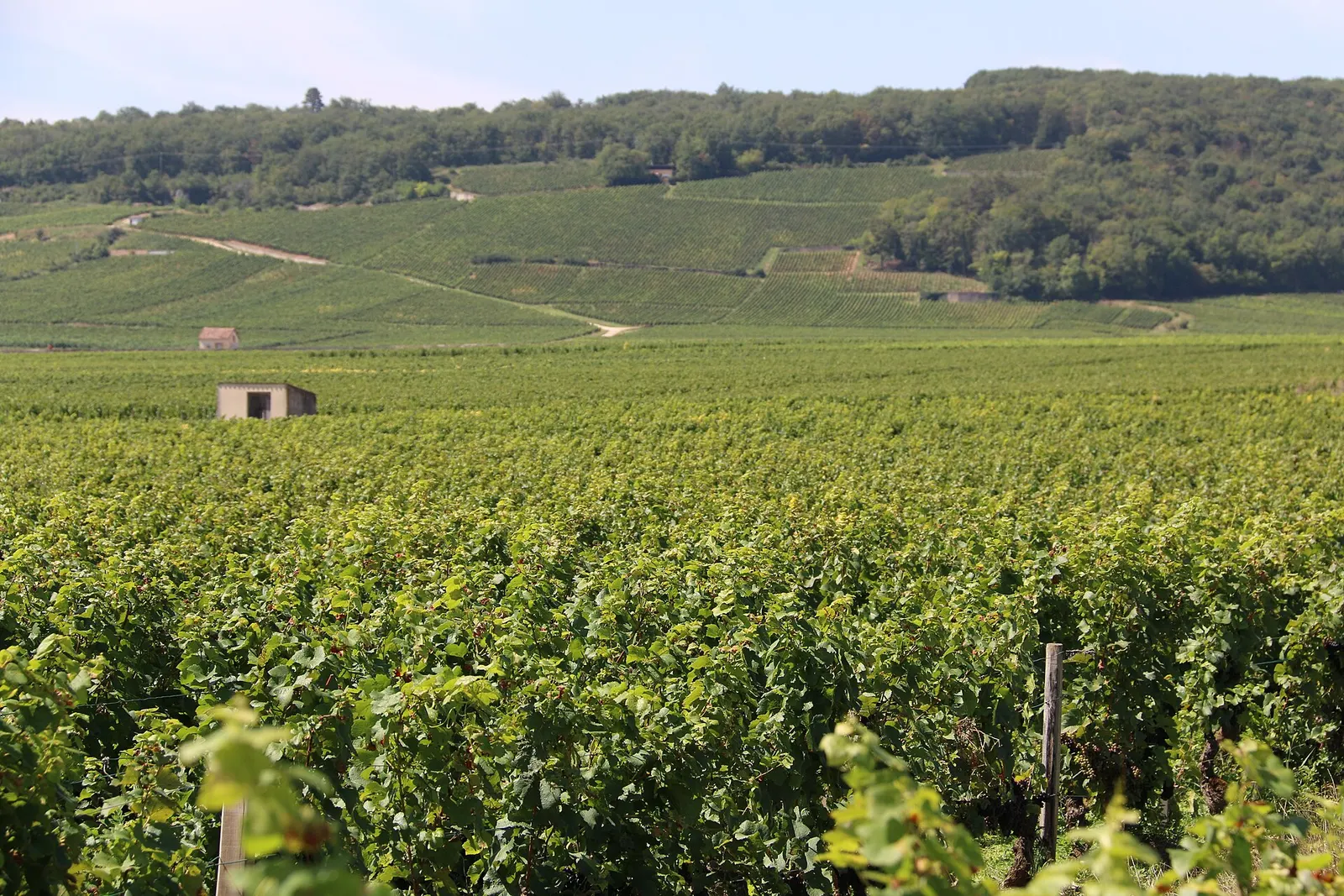
Look for the physical traces UNESCO describes: walls around clos, meurgers (heaps of stones cleared from the vines), cabottes (dry-stone huts), hedges and the tracks that follow old parcel boundaries. At Vosne-Romanée, a stone cross marks the edge of La Romanée-Conti vineyard; at Vougeot, the Cistercian wall still encloses the Clos in one block.
The climats are private, working vineyards, so stay on the tracks and never walk between the rows. A day with a driver makes the listed site easy to read and lets everyone taste: a morning in the Côte de Nuits with the Clos de Vougeot, lunch in Beaune and an afternoon along the Côte de Beaune fit comfortably into our full-day tour, 8 hours for 560 euros, with tastings paid to the domaines.
Outside the listed area, the Cité des Climats et vins de Bourgogne, Chablis and the Cité des Climats et vins de Bourgogne, Mâcon explain the northern and southern vineyards of Burgundy.
Does the UNESCO listing change anything for visitors?
Not in practice: there is no ticket and no single entrance, and the vineyards remain farmland. According to the Association des Climats, the listing adds no new supranational regulation; protection relies on existing French heritage, planning and environmental law, the appellation rules and the Territorial Charter, while day-to-day coordination falls to the Mission Climats. For visitors it has brought signposted trails, interpretation centres and a strong local commitment to keeping the landscape as it is.
Questions
UNESCO counts 1,247 climats in the listed area of the Côte de Nuits and the Côte de Beaune. Other Burgundy vineyards, such as Chablis, also have named climats, but they lie outside the World Heritage site.
Sources