10 min read · Written and checked by Côte Privée, updated
Burgundy has 33 grand cru appellations: 24 in the Côte de Nuits, 8 in the Côte de Beaune and Chablis Grand Cru, which is divided into seven climats. Together they cover about 555 hectares in production and give about 1% of Burgundy's wine, from La Romanée at 0.85 hectares to Chablis Grand Cru at about 101. This guide lists all of them with their villages, colours and sizes, using the Burgundy wine board's figures for 2022.
In short
- There are 33 grand cru AOCs: 24 in the Côte de Nuits, 8 in the Côte de Beaune and Chablis Grand Cru.
- Gevrey-Chambertin has the most, with nine; Vosne-Romanée has six.
- Every Côte de Nuits grand cru is red except Musigny, which also makes a little white; Corton is the only red grand cru of the Côte de Beaune.
- Sizes run from 0.85 ha for La Romanée to about 49 ha for the Clos de Vougeot, 91 ha for Corton and 101 ha for Chablis Grand Cru (BIVB, 2022).
How many grand crus are there in Burgundy?
Burgundy has 33 grand cru appellations, each with its own AOC specification. Twenty-four lie in the Côte de Nuits, eight in the Côte de Beaune, and Chablis has one appellation, Chablis Grand Cru, split into seven climats whose names may appear on the label.
A count of 39 appears when the seven Chablis climats are counted one by one, but officially they form a single appellation. Two more quirks are worth knowing. Mazoyères-Chambertin is usually sold as Charmes-Chambertin, whose delimited area includes it, and the Charlemagne appellation is not in use: its wine is sold as Corton-Charlemagne (BIVB).
Most grands crus were created by decrees of 1936 and 1937. The last two promotions came much later: the Clos des Lambrays in 1981 and La Grande Rue in 1992, both in the Côte de Nuits.
What are all 33 grand crus of Burgundy?
The table runs along the Côte from north to south, then to Chablis. Areas are the surface in production in 2022 published by BIVB, rounded; the delimited area can be slightly larger, as with the Clos de Vougeot, whose walls enclose 50.59 hectares. Style notes describe tendencies: the grower and the vintage count as much as the vineyard.
| Grand cru | Village(s) | Colour | Area in production, ha (BIVB 2022) | Character |
|---|---|---|---|---|
| Chambertin | Gevrey-Chambertin | Red | 13.1 | Gevrey's historic flagship: dense, firmly built Pinot Noir for long ageing. |
| Chambertin-Clos de Bèze | Gevrey-Chambertin | Red | 15.0 | A monastic clos recorded since the 7th century, next to Chambertin; its wine may also be sold as Chambertin. |
| Chapelle-Chambertin | Gevrey-Chambertin | Red | 5.2 | Below Clos de Bèze, next to Griotte; usually lighter-framed and fragrant. |
| Charmes-Chambertin | Gevrey-Chambertin | Red | 27.8 | Gevrey's largest grand cru, below the Route des Grands Crus; generous and approachable relatively young. |
| Griotte-Chambertin | Gevrey-Chambertin | Red | 2.7 | One of the smallest grands crus, below Chambertin; perfumed and fruit-led. |
| Latricières-Chambertin | Gevrey-Chambertin | Red | 7.3 | Continues Chambertin south to the Morey boundary; firm and spicy. |
| Mazis-Chambertin | Gevrey-Chambertin | Red | 8.7 | North of Clos de Bèze; dark-fruited, deep and powerful. |
| Mazoyères-Chambertin | Gevrey-Chambertin | Red | 2.9 under its own name | Shares its delimited area with Charmes-Chambertin, the name most growers use. |
| Ruchottes-Chambertin | Gevrey-Chambertin | Red | 3.3 | High on the slope above Mazis on thin soil; taut and slow to open. |
| Clos de la Roche | Morey-Saint-Denis | Red | 16.7 | Morey's largest grand cru, on soil barely 30 cm deep with large boulders (BIVB); deep and long-lived. |
| Clos Saint-Denis | Morey-Saint-Denis | Red | 6.2 | Named after the collegiate church of Saint-Denis at Vergy; fine-grained and nuanced. |
| Clos des Lambrays | Morey-Saint-Denis | Red | 8.7 | Promoted in 1981 and almost entirely owned by one estate; silky and aromatic. |
| Clos de Tart | Morey-Saint-Denis | Red | 7.4 | A walled monopole, held by the Cistercian nuns of Tart from 1141; structured and long-lived. |
| Bonnes-Mares | Chambolle-Musigny and Morey-Saint-Denis | Red | 15.0 | Mostly in Chambolle with a small part in Morey; the firmest, most structured Chambolle grand cru. |
| Musigny | Chambolle-Musigny | Red and white | 10.8, of which 0.66 white | Perfume and silk; its limits were set in 1929, before the AOC system, and it is the only Côte de Nuits grand cru allowed to make white wine. |
| Clos de Vougeot | Vougeot | Red | 49.4 | The Cistercians' walled clos, begun around 1110; divided among many owners, so styles vary widely. |
| Échezeaux | Flagey-Échezeaux | Red | 36.3 | Large and varied, from 230 to just over 300 m; from supple to serious. |
| Grands-Échezeaux | Flagey-Échezeaux | Red | 9.1 | Beside the upper wall of the Clos de Vougeot on even clay-limestone; deeper and more consistent than Échezeaux. |
| Richebourg | Vosne-Romanée | Red | 7.2 | Rich, velvety and opulent. |
| Romanée-Saint-Vivant | Vosne-Romanée | Red | 9.4 | Named after the monks of the Abbaye de Saint-Vivant de Vergy; deeper soils than Romanée-Conti (BIVB); perfumed and silky. |
| Romanée-Conti | Vosne-Romanée | Red | 1.8 | Monopole of the Domaine de la Romanée-Conti, named after the Prince of Conti, who bought it in 1760. |
| La Romanée | Vosne-Romanée | Red | 0.85 | The smallest grand cru, a monopole on a 12% slope just above Romanée-Conti. |
| La Tâche | Vosne-Romanée | Red | 5.9 | Monopole of the Domaine de la Romanée-Conti; dense, spicy and complex. |
| La Grande Rue | Vosne-Romanée | Red | 1.7 | A narrow monopole between La Tâche and Romanée-Conti, promoted in 1992. |
| Corton | Aloxe-Corton, Ladoix-Serrigny, Pernand-Vergelesses | Red, a little white | 91.0, of which 4.0 white | The largest grand cru of the Côte d'Or; reds may add one of 24 climat names, such as Les Bressandes. |
| Corton-Charlemagne | Aloxe-Corton, Ladoix-Serrigny, Pernand-Vergelesses | White | 59.8 | The steep upper slopes of the hill of Corton, much of it facing south-west (BIVB); powerful and mineral. |
| Charlemagne | Aloxe-Corton, Pernand-Vergelesses | White | Not used | A separate appellation inside Corton-Charlemagne's area; its wine is sold as Corton-Charlemagne (BIVB). |
| Montrachet | Puligny-Montrachet and Chassagne-Montrachet | White | 7.8 | Split between the two villages; widely held to be the reference for great Chardonnay. |
| Chevalier-Montrachet | Puligny-Montrachet | White | 7.0 | Above Montrachet at 265 to 290 m on thin, stony soil; taut and precise. |
| Bâtard-Montrachet | Puligny-Montrachet and Chassagne-Montrachet | White | 11.2 | Below Montrachet on deeper brown limestone soils; broad and rich. |
| Bienvenues-Bâtard-Montrachet | Puligny-Montrachet | White | 3.7 | A corner of the lower slope next to Bâtard; rich, often a little more delicate. |
| Criots-Bâtard-Montrachet | Chassagne-Montrachet | White | 1.6 | The smallest of the Montrachet family, entirely in Chassagne; rarely seen. |
| Chablis Grand Cru | Chablis | White | 100.9 | One hillside north-east of the town on Kimmeridgian limestone and marl; mineral and long-lived, with seven named climats. |
Which village has the most grand crus?
Gevrey-Chambertin has the most, with nine, followed by Vosne-Romanée with six and Morey-Saint-Denis with four of its own plus a share of Bonnes-Mares.
| Village | Grands crus | Count |
|---|---|---|
| Gevrey-Chambertin | Chambertin, Chambertin-Clos de Bèze, Chapelle, Charmes, Griotte, Latricières, Mazis, Mazoyères and Ruchottes-Chambertin | 9 |
| Morey-Saint-Denis | Clos de la Roche, Clos Saint-Denis, Clos des Lambrays, Clos de Tart and part of Bonnes-Mares | 5, one shared |
| Chambolle-Musigny | Musigny and most of Bonnes-Mares | 2, one shared |
| Vougeot | Clos de Vougeot | 1 |
| Flagey-Échezeaux | Échezeaux and Grands-Échezeaux | 2 |
| Vosne-Romanée | Romanée-Conti, La Romanée, La Tâche, Richebourg, Romanée-Saint-Vivant and La Grande Rue | 6 |
| Ladoix-Serrigny | Corton and Corton-Charlemagne | 2, both shared |
| Aloxe-Corton | Corton, Corton-Charlemagne and Charlemagne | 3, all shared |
| Pernand-Vergelesses | Corton, Corton-Charlemagne and Charlemagne | 3, all shared |
| Puligny-Montrachet | Montrachet, Chevalier-Montrachet, Bâtard-Montrachet and Bienvenues-Bâtard-Montrachet | 4, two shared |
| Chassagne-Montrachet | Montrachet, Bâtard-Montrachet and Criots-Bâtard-Montrachet | 3, two shared |
| Chablis | Chablis Grand Cru, with seven climats | 1 |
Do Meursault, Pommard, Volnay and Nuits-Saint-Georges have grand crus?
No. Some of Burgundy's most famous villages have no grand cru at all: Nuits-Saint-Georges, Pommard, Volnay, Meursault and Beaune reach their peak with premiers crus, such as Les Saint-Georges in Nuits-Saint-Georges or Les Perrières in Meursault. Their best wines can rival grands crus, but the label will always carry the village name.
How are the grand crus distributed along the Côte?
The grands crus of the Côte d'Or fall into three groups: an almost continuous band from Gevrey-Chambertin to Vosne-Romanée in the Côte de Nuits, the hill of Corton at the northern end of the Côte de Beaune, and the Montrachet slope between Puligny and Chassagne.
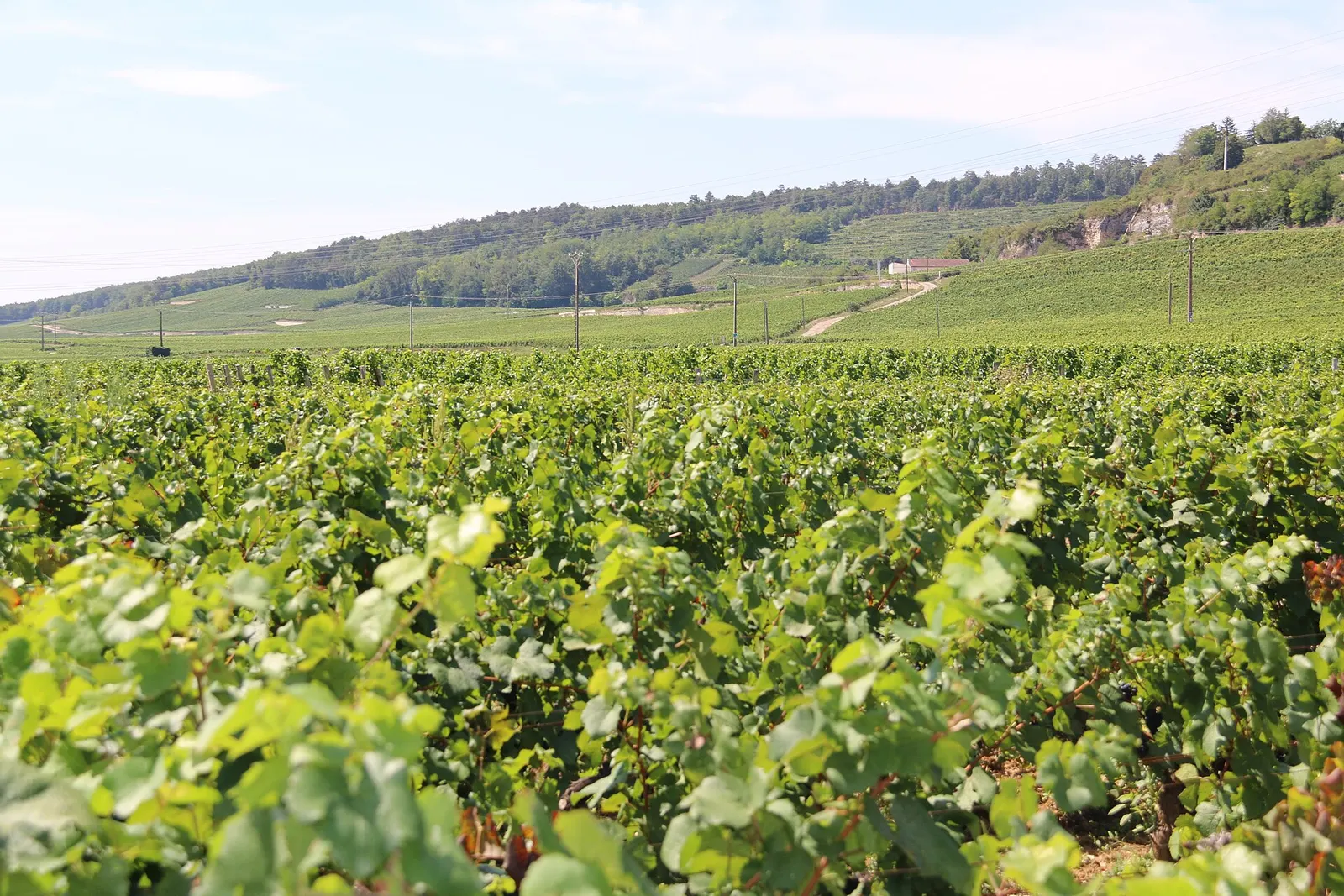
In the Côte de Nuits they follow the middle of the east-facing slope, at roughly 230 to 310 metres according to BIVB, between the thin, stony soils near the woods and the deeper ground towards the plain. At Gevrey-Chambertin they line both sides of the Route des Grands Crus, with Chambertin and Latricières above the road and Charmes below it. Morey's clos continue southwards, then come Bonnes-Mares and Musigny around Chambolle, the Clos de Vougeot, the two Échezeaux and the six grands crus of Vosne-Romanée. South of Vosne there are none: the best sites of Nuits-Saint-Georges are premiers crus.
The Côte de Beaune has only two clusters. The hill of Corton rises as an isolated, wooded dome with vines on three sides, between about 250 and 330 metres: red Corton mostly at mid-slope, white Corton-Charlemagne on the steep, marly upper slopes. After a long gap through Beaune, Pommard, Volnay and Meursault come the five Montrachet grands crus, stacked between about 240 and 290 metres: Chevalier-Montrachet at the top, Montrachet in the middle, then Bâtard-Montrachet, Bienvenues-Bâtard-Montrachet and Criots-Bâtard-Montrachet lower down.
Chablis stands apart, about 135 km north-west of Beaune by road. Its seven grand cru climats form one continuous band on the right bank of the Serein, north-east of the town, between about 100 and 250 metres, on Kimmeridgian marl and limestone full of tiny fossil oysters (BIVB).
What are the seven Chablis grand cru climats?
Chablis Grand Cru is a single appellation, recognised on 13 January 1938, covering about 101 hectares in production. From north-west to south-east its climats are Bougros, Preuses, Vaudésir, Grenouilles, Valmur, Les Clos and Blanchot, and a small area is declared without a climat name.
Les Clos is the largest and, according to BIVB, may be the original heart of the Chablis vineyard, first worked by the Cistercians of Pontigny. La Moutonne, the monopole of Château Long-Depaquit, is a traditional name for a plot straddling Vaudésir and Preuses, not an official eighth climat. The Cité des Climats et vins de Bourgogne, Chablis, in the town centre, is the best place to start.
| Climat | Area in production, ha (BIVB 2022) |
|---|---|
| Les Clos | 25.8 |
| Bougros | 15.1 |
| Vaudésir | 13.6 |
| Blanchot | 12.5 |
| Preuses | 11.3 |
| Valmur | 10.4 |
| Grenouilles | 9.4 |
| Declared without a climat name | 2.9 |
| Total Chablis Grand Cru | 100.9 |
Which grand crus are monopoles?
A monopole is a vineyard with a single owner. Among the grands crus, Romanée-Conti and La Tâche belong to the Domaine de la Romanée-Conti, La Romanée to the Domaine du Comte Liger-Belair and La Grande Rue to the Domaine François Lamarche, and the Clos de Tart has one owner. The Clos des Lambrays is almost entirely held by a single estate.
Everywhere else ownership is divided, sometimes extremely so. The Clos de Vougeot's 50 hectares are shared among many owners, some with only a few rows. This is why, in Burgundy, the producer's name matters as much as the vineyard's.
Can you visit Burgundy’s grand crus?
Yes, you can see every grand cru from public roads and tracks, but the vineyards are private property and working farmland. Stay on the tracks, never walk between the rows, do not touch or pick the grapes, take nothing from the ground, and give way to tractors, especially at harvest time.
- Clos de Vougeot: the Château du Clos de Vougeot, in the middle of the walled vineyard, is open to visitors all year, with the monks' great cellar and giant presses. Allow at least an hour.
- Romanée-Conti: a stone cross stands at the edge of La Romanée-Conti vineyard above Vosne-Romanée, next to Romanée-Saint-Vivant and Richebourg. Look from the lane and keep off the vines.
- Gevrey-Chambertin: the Route des Grands Crus runs between Chambertin above and Charmes-Chambertin below, towards Morey-Saint-Denis. Parking is limited on this narrow road, so stop only where it is safe.
- Hill of Corton: paths climb from Pernand-Vergelesses towards the wooded summit, with views over the Corton-Charlemagne slopes; Aloxe-Corton sits at the foot.
- Montrachet: park in Puligny-Montrachet and walk up the lanes to where Chevalier-Montrachet, Montrachet and Bâtard-Montrachet lie one above the other.
- Chablis: the grand cru hillside faces the town across the Serein, a short drive from the centre.
Can you taste grand cru wines when you visit?
Sometimes, but rarely by chance. Few domaines pour grands crus at the cellar door, most visits are by appointment, and some famous estates do not receive the public at all. Some wine houses in Beaune offer tastings that include a grand cru, usually for a fee.
Seeing the slopes with a driver lets everyone taste and saves searching for parking on narrow vineyard lanes. Our full-day tour, 8 hours for 560 euros, covers the Côte de Nuits grands crus and the Montrachet slope comfortably, and a long day of 12 hours for 880 euros can add Chablis. Tastings are paid directly to the domaines.
Questions
33 grand cru appellations: 24 in the Côte de Nuits, 8 in the Côte de Beaune and Chablis Grand Cru, which has seven named climats.
Sources