9 min read · Written and checked by Côte Privée, updated
The Côte de Nuits and the Côte de Beaune are the two halves of the Côte d'Or, the escarpment that runs south from Dijon to the Maranges. The Côte de Nuits is narrower, almost entirely red and holds 24 of Burgundy's 33 grands crus; the Côte de Beaune has about twice the vineyard area, makes great reds as well as Burgundy's most famous whites, and has 8 grands crus. Beaune sits between them, and every village on either côte is within about 35 minutes' drive.
In short
- Both are about 20 km long (BIVB): the Côte de Nuits from Dijon to Corgoloin, the Côte de Beaune from Ladoix-Serrigny to the Maranges.
- Village, premier cru and grand cru vineyards cover about 6% of Burgundy's area in the Côte de Nuits and 13% in the Côte de Beaune (BIVB, 2024).
- The Côte de Nuits is about 95% red by area; the Côte de Beaune about 60% red and 40% white (our sum of BIVB's 2022 appellation figures).
- Grands crus: 24 in the Côte de Nuits, all red except Musigny; 8 in the Côte de Beaune, all white except Corton.
Where are the Côte de Nuits and the Côte de Beaune?
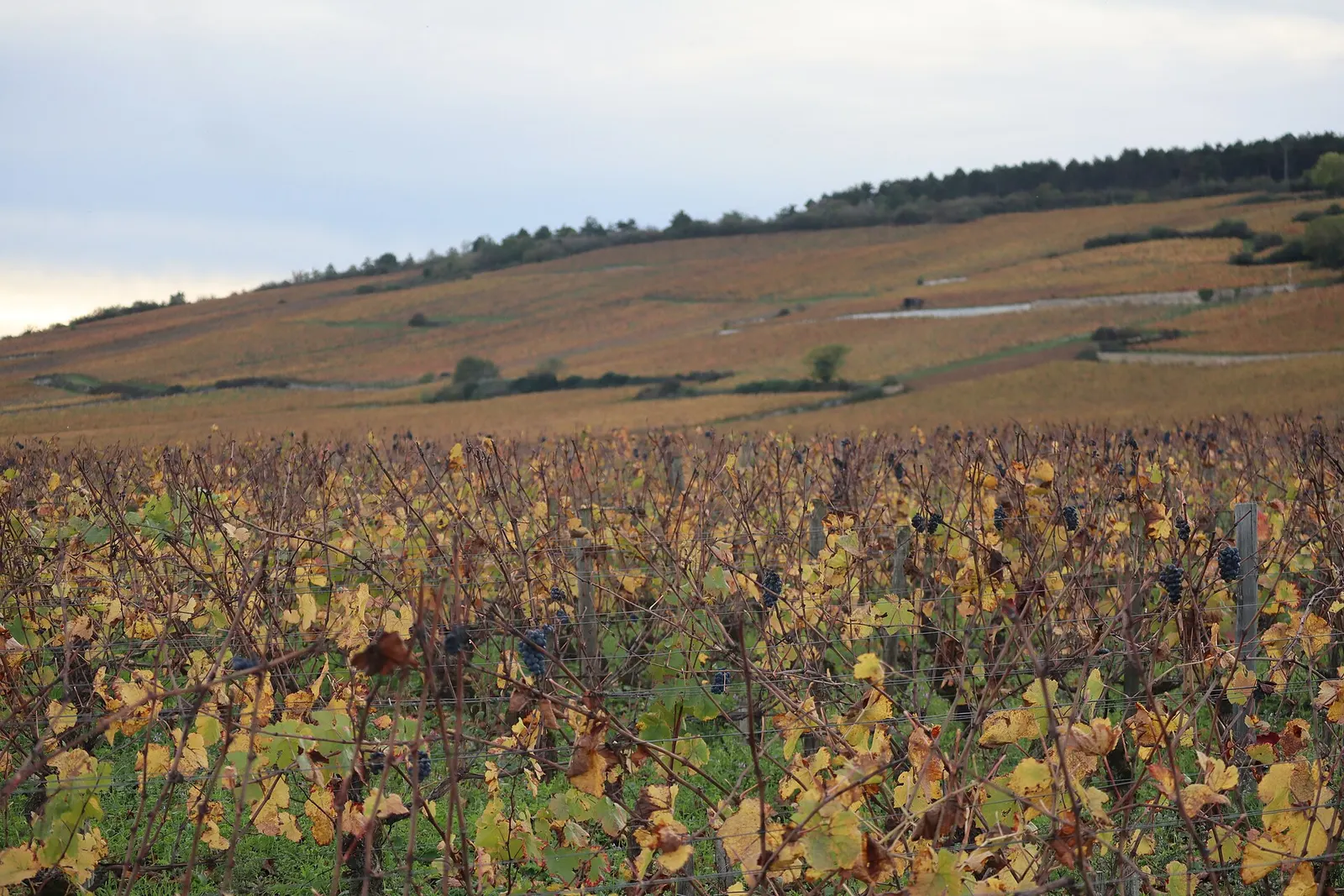
Both lie on the same east-facing escarpment, the Côte d'Or, above the Saône plain. The Côte de Nuits is the northern half, from the edge of Dijon to Corgoloin; the Côte de Beaune is the southern half, from Ladoix-Serrigny to the Maranges.
BIVB describes each as about 20 km long. The Côte de Nuits is a narrow ribbon, only 200 to 300 metres wide in places, between the wooded hills and the plain. The Côte de Beaune is broader and more open, cut by side valleys that lead to villages such as Saint-Romain, Auxey-Duresses and Saint-Aubin. The two meet between Corgoloin and Ladoix-Serrigny, where the vines mingle with the stone quarries of Comblanchien.
Behind each côte lie the Hautes-Côtes, higher ground at around 300 to 400 metres with its own regional appellations, Bourgogne Hautes Côtes de Nuits and Bourgogne Hautes Côtes de Beaune.
| Feature | Côte de Nuits | Côte de Beaune |
|---|---|---|
| Extent | Dijon to Corgoloin, about 20 km | Ladoix-Serrigny to the Maranges, about 20 km |
| Village-level vineyard and above | About 6% of Burgundy's area, roughly 1,900 to 2,000 ha | About 13% of Burgundy's area, roughly 4,000 ha |
| Colour by area | About 95% red | About 60% red, 40% white |
| Grands crus | 24, all red except Musigny | 8: Corton, mostly red, and seven whites |
| Main rocks | Middle Jurassic limestones and marls, including hard Comblanchien limestone | Younger Upper Jurassic marls and limestones between Ladoix and Meursault, harder limestone again further south |
| Signature villages | Gevrey-Chambertin, Chambolle-Musigny, Vosne-Romanée, Nuits-Saint-Georges | Aloxe-Corton, Pommard, Volnay, Meursault, Puligny-Montrachet |
| Main town | Nuits-Saint-Georges | Beaune |
| Drive from Beaune | About 20 to 35 minutes | About 5 to 30 minutes |
How do the soils differ between the Côte de Nuits and the Côte de Beaune?
Both côtes are limestone and marl laid down in Jurassic seas, but the Côte de Nuits sits mainly on older, harder Middle Jurassic rock, while much of the Côte de Beaune shows younger, softer and marlier Upper Jurassic layers.
The Côte exists because of faulting. Around 30 million years ago the Saône basin subsided, leaving the east-facing escarpment, and a web of smaller faults set rocks of different ages side by side, which is why soils change from one plot to the next, as the Association des Climats explains. In the Côte de Nuits, BIVB describes Bathonian limestone high on the slope at Gevrey-Chambertin with Bajocian marls and limestones below, and hard Premeaux limestone beneath the grands crus of Vosne-Romanée.
According to BIVB, the hard Comblanchien limestone disappears underground around Nuits-Saint-Georges and reappears at Meursault, where red gives way to white. In between, from Ladoix to Meursault, the slope exposes younger Oxfordian limestones and marls, visible in textbook section on the hill of Corton, where Pinot Noir takes the mid-slope and Chardonnay the marly upper slopes. Marl-rich soils tend to favour Chardonnay, which helps explain why the great whites cluster in the Côte de Beaune.
Which grapes grow in each côte?
The Côte de Nuits is Pinot Noir country, while the Côte de Beaune grows Pinot Noir and Chardonnay in roughly a 60 to 40 split by area.
Adding up BIVB's 2022 figures for the village, premier cru and grand cru appellations gives about 1,840 hectares of red and rosé against about 95 hectares of white in the Côte de Nuits, and about 2,440 hectares of red against about 1,530 of white in the Côte de Beaune.
Whites are rarities in the Côte de Nuits. Marsannay-la-Côte makes the most, from about 50 hectares in 2022, and also makes rosé; smaller amounts come from Vougeot, Nuits-Saint-Georges, Morey-Saint-Denis, Fixin and the grand cru Musigny. In the Côte de Beaune, BIVB notes that Pinot Noir dominates around Beaune, in Volnay, Pommard and Ladoix-Serrigny for instance, and that Chardonnay takes over from Meursault southwards: Meursault had about 383 hectares of Chardonnay against 9 of Pinot Noir in 2022, and Puligny-Montrachet is almost entirely white. Chassagne-Montrachet and Santenay still make serious reds.
How do the wines of the two côtes taste?
As a rule, Côte de Nuits reds are deeper, firmer and longer-lived, Côte de Beaune reds are softer and more approachable young, and the Côte de Beaune's whites have no equal in the Côte de Nuits.
In the Côte de Nuits, Gevrey-Chambertin tends towards structure and dark fruit, Chambolle-Musigny towards perfume and silky tannins, Morey-Saint-Denis sits between the two, Vosne-Romanée is velvety and spicy, and Nuits-Saint-Georges firm and earthy. In the Côte de Beaune, Volnay is known for finesse and floral perfume, Pommard for firmer tannins, Beaune and Savigny-lès-Beaune for supple, fruity reds, and red Corton for power.
The whites follow the same logic of place. Corton-Charlemagne is tense and mineral, Meursault rounder, often with hazelnut and toasted notes, Puligny-Montrachet more precise and floral, and Chassagne-Montrachet somewhere between the two. These are tendencies rather than rules: the producer, the vintage and the exact climat matter as much as the côte.
How many grand crus are in each côte?
The Côte de Nuits has 24 grands crus and the Côte de Beaune 8, even though the Côte de Beaune has about twice the vineyard area.
- Côte de Nuits, 24: nine in Gevrey-Chambertin; Clos de la Roche, Clos Saint-Denis, Clos des Lambrays and Clos de Tart in Morey-Saint-Denis; Bonnes-Mares, shared between Morey and Chambolle-Musigny; Musigny; the Clos de Vougeot; Échezeaux and Grands-Échezeaux in Flagey-Échezeaux; and six in Vosne-Romanée, including Romanée-Conti and La Tâche.
- Côte de Beaune, 8: Corton, Corton-Charlemagne and Charlemagne on the hill of Corton, shared by Aloxe-Corton, Ladoix-Serrigny and Pernand-Vergelesses; and Montrachet, Chevalier-Montrachet, Bâtard-Montrachet, Bienvenues-Bâtard-Montrachet and Criots-Bâtard-Montrachet in Puligny-Montrachet and Chassagne-Montrachet.
Which famous villages have no grand cru?
Beaune, Pommard, Volnay and Meursault in the Côte de Beaune, and Nuits-Saint-Georges in the Côte de Nuits, have premiers crus but no grand cru. Their finest climats, such as Les Rugiens in Pommard, Les Perrières in Meursault or Les Saint-Georges in Nuits-Saint-Georges, are classified premier cru. In the Côte de Beaune, Corton is the only red grand cru; the other seven are white.
Which villages are in the Côte de Nuits and the Côte de Beaune?
The Côte de Nuits takes its name from Nuits-Saint-Georges, its main town, and the Côte de Beaune from Beaune, Burgundy's main wine town and home to many négociant houses. Villages from north to south:
| Côte | Wine villages, north to south |
|---|---|
| Côte de Nuits | Marsannay-la-Côte, Fixin, Gevrey-Chambertin, Morey-Saint-Denis, Chambolle-Musigny, Vougeot, Flagey-Échezeaux, Vosne-Romanée, Nuits-Saint-Georges, Premeaux-Prissey, plus Brochon, Comblanchien and Corgoloin in the Côte de Nuits-Villages appellation |
| Côte de Beaune | Ladoix-Serrigny, Aloxe-Corton, Pernand-Vergelesses, Savigny-lès-Beaune, Chorey-lès-Beaune, Beaune, Pommard, Volnay, Monthélie, Meursault, Auxey-Duresses, Saint-Romain, Blagny, Puligny-Montrachet, Saint-Aubin, Chassagne-Montrachet, Santenay, Maranges |
How should you plan a day in the Côte de Nuits?
Follow the Route des Grands Crus from one end to the other, with one set piece, the Château du Clos de Vougeot, and two tastings booked in advance.
- Morning: Gevrey-Chambertin, about 30 to 35 minutes from Beaune, then the grand cru road towards Morey-Saint-Denis and a first tasting.
- Late morning: Chambolle-Musigny, then a short walk south to the premier cru Les Amoureuses and the grand cru Musigny, just above the Clos de Vougeot.
- Lunch: in Gevrey-Chambertin, Vougeot or Nuits-Saint-Georges.
- Afternoon: the Château du Clos de Vougeot, allowing about an hour, then Vosne-Romanée and the stone cross of La Romanée-Conti vineyard, and a second tasting in Vosne-Romanée or Nuits-Saint-Georges.
How should you plan a day in the Côte de Beaune?
The Côte de Beaune suits a loop from Beaune: north to the hill of Corton, then south through the red villages to the great whites of Meursault, Puligny-Montrachet and Chassagne-Montrachet.
- Morning: Aloxe-Corton and Pernand-Vergelesses, 8 to 11 minutes from Beaune, for the hill of Corton and a tasting of red Corton or Corton-Charlemagne.
- Late morning: Pommard and Volnay, two red-wine villages side by side; the Château de Pommard receives visitors for tastings.
- Lunch: in Meursault or Puligny-Montrachet.
- Afternoon: the cellars of the Château de Meursault or a grower in the village, then the Montrachet slope on foot from Puligny-Montrachet, with Saint-Aubin or Chassagne-Montrachet as a last stop.
Can you visit both côtes in one day?
Yes. The whole Côte d'Or is about 50 km long with Beaune in the middle, so a morning in one côte and an afternoon in the other is realistic with two or three tastings. Most domaines receive visitors by appointment, often on weekdays, and many pause for lunch, so book ahead and keep the plan loose.
Since every stop involves tasting, a driver means nobody in the group has to drive. Our half-day tour, 4 hours for 290 euros, covers one côte well; the full day, 8 hours for 560 euros, covers both. Tastings are paid directly to the domaines.
Questions
Neither is better overall. The Côte de Nuits is the place for great red Pinot Noir and most of the grands crus, while the Côte de Beaune offers fine reds and Burgundy's greatest white wines. Choose by the wines you enjoy.
Sources